Dental Bridges in Allen With Dr. Linda Jacob
A fixed way to close the gap left by a missing tooth, explained step by step before any work begins.
- 16 Yearsin Allen
- Family Ownedhomegrown practice
- Paperlessoffice
- Digital X Raysshown on screen
Dental Bridges in Allen are a fixed way to replace one or more missing teeth by joining a false tooth to the natural teeth on either side of the gap. Dr. Linda Jacob explains the whole plan first, including what a bridge is called, what it involves and what other choices you have.
A bridge does not come out at night the way a denture does, and it does not need surgery the way an implant does. It does ask something of the neighboring teeth, though, and Dr. Jacob wants you to hear about that trade before you agree to it. Her patients in Allen, McKinney and Plano usually leave the first visit with a clear picture of what is possible.
Bridge Basics
What Dental Bridges in Allen Are and How They Are Built
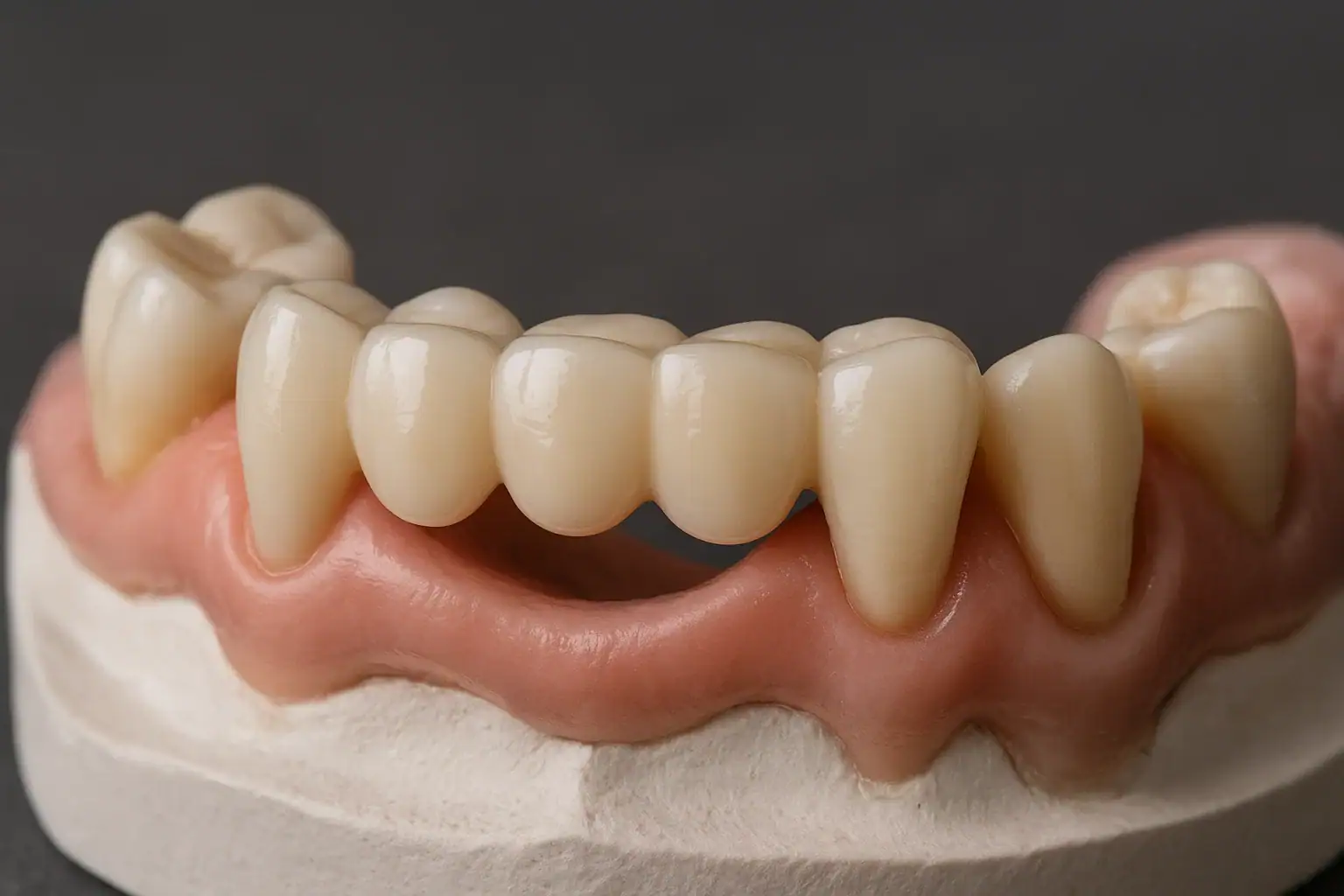
A dental bridge is a non removable prosthesis attached to the natural teeth that remain in your mouth. The false tooth that fills the gap is called a pontic. The natural teeth on each side that hold it in place are called abutment teeth, and each one is shaped and covered with a crown that is joined to the pontic.
Because the three or more pieces are made as one unit, the bridge is cemented in as a single span. You brush and chew on it the way you would on your own teeth. Every bridge Dr. Jacob plans is made in a dental laboratory, like a single crown, which is why the treatment takes more than one visit. If you want to read about the crown part of the work, our page on dental crowns in Allen describes the materials and steps.
The three parts of a bridge
The pontic replaces the missing tooth and is shaped to match the teeth around it. The abutment crowns fit over the supporting teeth and carry the chewing load. The cement and the lab made connection hold everything together as one piece.
An Honest Start
Why Every Bridge Plan Starts With a Conversation About Options
For a long time a bridge was the most accepted answer for a lost tooth, here in Allen and everywhere else. It worked well and looked natural, and many people still have one that has served them for years. Dentistry has more choices now, and Dr. Jacob says so plainly.
At Sunrise Dental we tell you the best solution for the space in your mouth, and in many cases a better option than a bridge exists. An implant, or a bridge supported by implants, may protect the neighboring teeth better. Our page on dental implants in Allen explains that route, and Dr. Jacob will tell you if a bridge, an implant or something else suits your mouth.
The reason is simple. To fit a traditional bridge, the natural teeth on both sides must be shaped down to hold the crowns. Those teeth then become more prone to decay, to plaque building up at the edges and to gum disease. In some cases a root canal is needed sooner than it otherwise would be, because part of the tooth above the gum has been removed.
The trade off for the neighboring teeth
- Shaped down to hold the crowns
- More prone to decay
- Plaque can build up at the edges
- Higher risk of gum disease
- A root canal may be needed sooner
That is why Dr. Jacob reviews implants and other options with you before recommending a bridge.
Candidates
Who May Be a Candidate: Missing Teeth Bridge Allen Patients Ask About
Patients who ask us about a missing teeth bridge Allen dentists can place usually have one thing in common. They have lost a tooth, or a short run of teeth, and the teeth beside the space are still strong. Dr. Jacob decides who is a good candidate by looking at those neighbors closely, because they will carry the load.
She examines the gums around them, checks the bite and reviews digital X rays to see how much healthy tooth and bone remain. A neighbor that already has a large filling or a crown may be a sensible support. A neighbor that is perfectly healthy and untouched may be better left alone, and that is when she talks about alternatives.
What happens when a gap is left open
Teeth lean toward an empty space over time. The tooth that bites against the missing one can slowly grow out of its place, and the bite changes. Chewing on one side more than the other is common, and food collects where the neighbors have tipped. None of this happens overnight, but it is the reason we encourage patients to plan replacement rather than wait.
Bring any questions about timing to your first visit. Some patients are ready to start right away. Others want to finish a root canal or treat gum problems around the gap before a bridge is made, and Dr. Jacob sequences the work so that each step makes the next one safer.
- 1Neighbors lean toward the space
- 2The opposite tooth grows out of place
- 3The bite changes
- 4Chewing shifts to one side
- 5Food collects where teeth tipped
The Process
How the Bridge Process Works at Sunrise Dental
A bridge is usually finished in two to three visits to our Allen office. Here is the order in which it usually goes, so nothing comes as a surprise.
What is a flipper?
A flipper is a small removable appliance that holds a false tooth in the gap for a short time. It is not a long term replacement, but it keeps the space looking natural while the lab finishes your bridge.
- 1
Exam and X rays. Dr. Jacob examines the space, the neighboring teeth and your gums, and takes digital X rays.
- 2
Planning. She explains the options and the steps, and you decide with her whether a bridge is the right choice.
- 3
Preparing the supporting teeth. The abutment teeth are shaped so crowns can fit over them, and the area is numbed first so you are comfortable.
- 4
Records for the lab. An accurate record of your teeth and bite is sent to the dental laboratory that makes the bridge.
- 5
A temporary. Until the permanent bridge arrives from the lab, Dr. Jacob can place a temporary bridge, temporary crowns or a flipper in place of the missing teeth.
- 6
Delivery. At the final visit she checks the fit and the bite, adjusts as needed and cements the bridge.
Once the bridge is cemented, your bite may feel a little different for a day or two while you get used to it. If one side still feels high when you close, call the office, because a small adjustment in the chair usually fixes it. Mild sensitivity to cold in the supporting teeth is also common at first and tends to settle.
Materials
Choosing a Porcelain Bridge Allen Patients Can Trust to Look Natural
A porcelain bridge is made to match the color and shape of your own teeth, so it blends with the smile around it. Dr. Jacob chooses the shade with you in the chair, in natural light where possible, so the finished bridge matches the teeth beside it. The same care we take with porcelain veneers in Allen goes into matching a bridge.
Bridges can be made from porcelain, from porcelain over a metal base or from other strong ceramic materials. Which material fits depends on where the gap is, how hard you bite and what the neighboring teeth need. A back tooth carries more force than a front tooth, so the choice often differs by location.
Bridge materials
- PorcelainMatched to the color and shape of your teeth
- Porcelain over metalPorcelain fused to a metal base
- Strong ceramicsOther high strength ceramic materials
What decides the choice
- Where the gap is
- How hard you bite
- What the neighbors need
Compare
A Tooth Bridge Allen Patients Can Compare With Other Replacements
When you weigh a tooth bridge Allen dentists can place against the other ways to fill a gap, it helps to see them side by side, with the bridge as one choice among several. Each one has a different effect on the neighboring teeth, on your gums and on how long the treatment takes.
Fixed bridge
Cemented to the neighboring teeth, with no removable parts. Needs the supporting teeth to be shaped, and takes two to three visits.
- Neighbors
- Shaped
- Removable
- No
Implant or implant supported bridge
Held by the jaw bone rather than by the neighbors, so the surrounding teeth are not shaped. Dr. Jacob places the crown and refers the surgery for the implant. Healing time is longer than for a bridge, but the neighbors stay untouched.
- Neighbors
- Untouched
- Removable
- No
Partial denture
A removable appliance that fills several gaps at once. Our partial dentures in Allen page covers the flexible kind, and the dentures in Allen page covers full sets for patients who have lost most of their teeth.
- Gaps
- Several at once
- Removable
- Yes
Seen next to those options, a fixed bridge makes the most sense when the neighboring teeth already need crowns or are heavily filled. In that case the shaping is less of a sacrifice. Dr. Jacob will tell you honestly when that is not your situation.
If the tooth has not been lost yet and you are weighing whether it can be saved, Dr. Jacob may suggest root canal in Allen first. If it has to come out, the plan for the space starts the same day with a conversation about tooth extraction in Allen.
Care
Caring for Your Bridge So It Lasts
A bridge does not decay, but the teeth under and beside it can. The edge where the crowns meet the gum is the place plaque likes to sit. Brush twice a day and clean under the false tooth every day.
A regular floss will not slip under a bridge, so you use a floss threader, a small brush made for the space or a water flosser. The team will show you which one suits your mouth and how to use it. Professional visits matter too, and the details are on our page about exams and cleanings in Allen.
- Floss threader
- Small interdental brush
- Water flosser
Avoid biting hard items such as ice or unpopped kernels with the bridge, since the span puts force on the supporting teeth. If you grind your teeth at night, ask about a custom night guard in Allen to protect the work. With good care a bridge can serve for many years, though no dental restoration lasts forever.
Coverage
Insurance and Your Bridge
Sunrise Dental is in network with most PPO and DPPO plans, including MetLife, Delta Dental, Cigna, Aetna, United Healthcare, United Concordia, GEHA, Connection Dental, Blue Cross Blue Shield and Guardian. Coverage for a bridge, and how much of the cost your plan shares, depends on the plan itself. The front desk checks your benefits before treatment so you know what to expect. See our dental insurance page for the current list.
For more on how bridges and other fixed restorations are described, the American Dental Association's MouthHealthy site is a plain language resource written for patients. The National Institute of Dental and Craniofacial Research also publishes patient information on oral health from the National Institutes of Health.
Where Patients Come From
Patients From Across North Texas Come to Us for Bridges
We see bridge patients from Allen, McKinney, Fairview, Plano, Frisco, Richardson, Addison, The Colony and Sherman. Many drive in because Dr. Jacob has treated their family for years, and a bridge is the kind of work people prefer to leave with a dentist they trust.
- Allen
- McKinney
- Fairview
- Plano
- Frisco
- Richardson
- Addison
- The Colony
- Sherman
Neighborhoods Around Our Allen Office
The office is minutes from Twin Creeks, Watters Creek, Montgomery Farm and Star Creek, along the Exchange Parkway and Watters Road corridor and close to Texas Health Presbyterian Hospital Allen. Neighbors who live nearby often choose our office for bridge work because of the short drive and the familiar faces.
- Twin Creeks
- Watters Creek
- Montgomery Farm
- Star Creek
- Exchange Parkway and Watters Road
- Near Texas Health Presbyterian Hospital Allen
Address1150 North Watters Road, Suite 104, Allen, TX 75013
HoursMonday to Friday, 8 AM to 5 PM. Closed weekends.
Get DirectionsAbout Sunrise Dental and Dr. Linda Jacob
Sunrise Dental is a family owned dental office at 1150 North Watters Road, Suite 104, Allen, TX 75013, near Exchange Parkway. Linda Jacob, DDS, a graduate of NYU College of Dentistry who has practiced in Allen for 16 years, provides dental bridges in Allen along with crowns, implant restorations, partial dentures and dentures. The office is open Monday to Friday, 8 AM to 5 PM, and closed Saturday and Sunday. Call (972) 908 3773 or email manager@sunrisedentalallen.com.
Our Team
Meet the Team Behind Your Bridge
Linda Jacob, DDS, leads every treatment plan and has practiced in Allen for 16 years. Kialani Johnson, RDA, has assisted at the practice since 2019, and Tracy Caminatra, who has worked in dentistry for more than 10 years, runs the front office. You can read more about them on our Our Team page.
-
Dentist and Owner
Linda Jacob, DDS
Leads every treatment plan.
-
Registered Dental Assistant
Kialani Johnson, RDA
Has assisted at the practice since 2019.
-
Front Office
Tracy Caminatra
Runs the front office, with more than 10 years in dentistry.
Patient Reviews
What Patients Say
Read what patients say about their visits on our Google Business Profile.
Frequently Asked Questions
Questions Patients Ask About Bridges
Want to talk through a bridge or another option? Call the front desk and ask for an exam of the gap.
Call the front desk(972) 908 3773Monday to Friday, 8 AM to 5 PMSunrise Dental completes a bridge in two to three visits. The first visit is for the exam and for preparing the supporting teeth, and the last is for fitting and cementing the finished bridge from the lab.
Sunrise Dental can place a temporary bridge, temporary crowns or a flipper so there is no gap in the meantime. Dr. Jacob will tell you which one she plans to use and how to care for it.
Sunrise Dental is honest about this. To hold a traditional bridge, the neighboring teeth are shaped down, which can make them more prone to decay and gum disease, and sometimes a root canal is needed sooner. That is one reason Dr. Jacob also reviews implants with you.
Sunrise Dental says the answer depends on your neighboring teeth, your gums and the bone under the gap. Dr. Jacob examines those and explains which option she would suggest and why, so the choice stays yours.
Sunrise Dental recommends a floss threader, a small interdental brush or a water flosser, used once a day. The team will show you the method that fits your bridge at the delivery visit or at a cleaning.
Sunrise Dental is in network with most PPO and DPPO plans, and the front desk checks your benefits for a bridge before treatment starts. Coverage differs by plan, so we explain it before you decide.
Next Step
Book a Visit to Talk About a Bridge
Call (972) 908 3773 or use our contact page to ask about a bridge or to book an exam of the gap. If you are new to the office, start with our new patients page. You can also read how we work on the Sunrise Dental homepage or see our reviews on Google.
Sunrise Dental, 1150 North Watters Road, Suite 104, Allen, TX 75013. (972) 908 3773. manager@sunrisedentalallen.com. Monday to Friday, 8 AM to 5 PM.
The information on this page is general patient education and is not a diagnosis or a promise of any result. Results vary by patient.